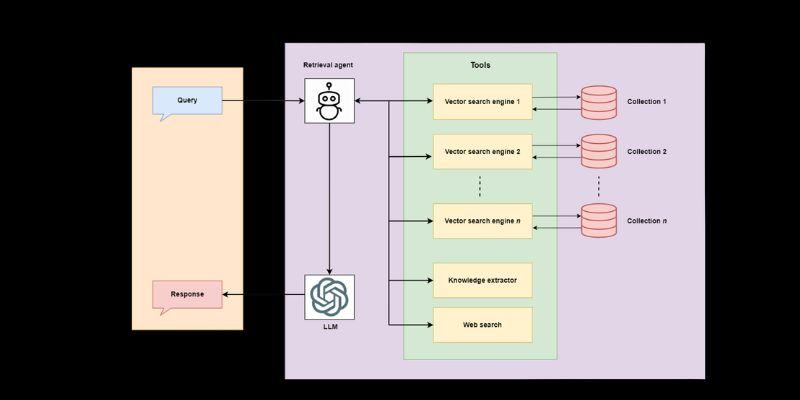
It can feel overwhelming to learn about AI agents from scratch, especially if you're just getting started. Exploring single agents, the building blocks of more complex systems, offers a practical starting point. Individual agents perceive their surroundings, engage with them, and use rules or strategies to guide their decisions.
Understanding single agents lays the foundation for grasping more complex multi-agent systems. These agents are widely applied in automation, robotics, and recommendation engines. Learning from the ground up helps you connect abstract concepts with real-world applications. This guide explains what single agents are, why they matter, and how they work—along with their design process, examples, and future potential.

What Are Single AI Agents?
Single AI agents are systems that sense their surroundings and act to achieve specific objectives. They function independently of other agents and are made with a specific goal in mind. Their choices are influenced by the signals, information, and feedback they receive from their surroundings.
A well-known example of a simple single-agent system is a thermostat that controls temperature. These agents interpret input and choose actions based on a perception-action cycle. Thanks to their simplicity, single agents are useful for teaching fundamental AI concepts. They also act as foundational elements for mastering complex multi-agent frameworks. Comprehending single agents helps learners hone their artificial intelligence problem-solving skills.
How Do Single Agents Work?
Perception is the first step in a structured process that single agents follow. They gather information from direct feedback, datasets, and sensors. The agent selects the best response using a decision-making function guided by rules, logic, or algorithms.
The agent selects an action and then applies it to the environment, resulting in new feedback or a new state. Until a goal is accomplished or circumstances change, this cycle continues. The constant flow guarantees that the agent gradually adjusts to new inputs. The strength of this design is its ability to function independently without constant human oversight. By examining these workflows, beginners can learn control theory and programming logic.
Types of Single AI Agents
Depending on how they make decisions, single agents can be divided into several types. Simple reflex agents don't take history into account; they only react to the situation at hand. However, model-based reflex agents make decisions based on historical data. Goal-based agents evaluate actions based on their contribution to achieving predetermined goals.
Utility-based agents weigh different actions to optimize performance or maximize success. These categories demonstrate the variety of single-agent designs. Depending on the complexity and resource requirements, each type is suitable for a specific task. For instance, a navigation system might require goal-based reasoning, whereas a vacuum cleaner robot might employ reflex models. Selecting the ideal design is made simpler by being aware of these differences.
Building Single Agents from Scratch
A methodical approach is necessary when building a single agent from the ground up. First, define the environment, including physical context, datasets, and input conditions. Next, define the objectives of the agent, such as sorting data, floor cleaning, or controlling energy consumption.
For gathering data, the design must incorporate sensors or other input techniques. Next, a decision-making model—whether algorithmic or rule-based—is introduced. Lastly, the agent's choices are applied to the surroundings using an actuator or output system. Beginners often use programming languages like Python to simulate these processes. For practice, small projects like maze-solving bots are helpful. Critical AI problem-solving abilities are developed at each stage of development.
Real-World Applications of Single Agents
Numerous industries use single agents, demonstrating their value in real-world situations. Simple agents operate machines in robotics to perform repetitive tasks, such as delivery or cleaning. Tasks such as tracking transactions and identifying trends are increasingly automated in the finance industry. Additionally, recommendation systems use agent-like behavior to provide users with suggestions based on their current input.
In the medical field, lone agents help with automated diagnostic support or patient data monitoring. Their autonomy boosts productivity and decreases human labor. By focusing on specific tasks, they deliver reliable results without the complexity of larger systems. These applications show the adaptability and practicality of single-agent design.
Advantages and Limitations of Single Agents
Learners and industries can benefit from single agents in several ways. They are inexpensive to implement, easy to comprehend, and straightforward to design. Their independence enables them to perform repetitive tasks effectively, reducing the need for human intervention. They do, however, have some obvious limitations.
They may find it challenging to complete tasks that require coordination or teamwork, as they often work independently. If the design is overly simplistic, it may limit their ability to make flexible decisions. Logical or perceptual errors can lead to poor outcomes. Recognizing both strengths and weaknesses helps developers apply them effectively. The secret to successful single-agent design is striking a balance between performance and simplicity.

The Future of Single AI Agents
The future of single agents rests in their potential as useful and instructive resources. They will continue to be essential to the teaching of AI concepts in training programs, colleges, and schools. Their designs may incorporate lightweight machine learning models to facilitate improved decision-making as technology advances.
Additionally, single agents will continue to be useful in sectors that require effective, task-oriented automation. While multi-agent systems may dominate large-scale applications, single agents will remain valuable for specialized tasks. They serve as stepping stones for students getting ready to study more complex systems. Their utility will increase as sensors, algorithms, and programming tools continue to advance. As a result, single agents will continue to play a crucial role in the field of AI.
Conclusion
Since single agents are the cornerstone of AI, novices must know how they work. They operate through environmental sensing, decision-making, and action toward predetermined objectives. Due to their adaptable design, they can be utilized in various fields, including automation, robotics, finance, and healthcare. Despite their limitations in comparison to multi-agent systems, their simplicity ensures reliability and user-friendliness. You can develop knowledge that supports both practical projects and advanced studies by learning how they work. Single agents remain valuable both as industry solutions and as teaching tools. The best way to begin investigating the larger field of AI is to master it first.