Thermodynamic computing isn’t theoretical anymore. What started as a branch of information physics has become a working engineering model. Researchers are building physical processors that use heat and energy gradients to solve optimization problems—something classical chips often fumble under scale. These experimental thermodynamic chips aren't meant to replace digital logic across the board, but in select workloads, they're showing signs of serious advantage.
That matters, especially in areas where conventional computing hits hard limits, like combinatorial optimization and stochastic modeling. The latest prototypes don't just consume less energy, they may compute differently—pushing computation closer to physical law than symbolic abstraction.
Thermodynamics as a Computational Substrate
Thermodynamic computing hinges on energy flow, not digital state. The core principle is simple: configure a system so that its most stable energy state encodes the solution to a problem. Instead of representing bits as voltage levels or magnetic spin, these systems use physical microstates—gradients of heat, pressure, or potential. A properly designed thermodynamic chip behaves like a physical optimizer. When constraints are encoded into the system, it naturally evolves toward the configuration that minimizes its internal energy. That final state corresponds to the best solution.

This turns traditional computing upside down. With digital logic, a processor performs millions of discrete operations to search solution spaces. A thermodynamic processor explores that space through direct physical transitions. Think of a network of nanoscale components, each influencing its neighbors through energy exchange. The system doesn’t follow a symbolic program. It’s set in motion and allowed to settle. It doesn’t simulate energy minimization—it embodies it.
Why Optimization Problems Fit This Model?
Most real-world applications that push computing limits aren’t linear. They involve huge search spaces with complex constraints—like traffic routing, drug discovery, scheduling, or protein folding. Solving these requires finding the best solution among an astronomical number of possibilities. These are the types of problems that break classical heuristics when the dimensionality grows.
Thermodynamic chips excel here because they don’t need to check each state. Their physical structure effectively lets them “relax” toward a global minimum. It’s not perfect—local minima are still a risk—but carefully engineered energy landscapes can reduce those traps. Where conventional CPUs use iterative loops or brute force, thermodynamic chips can converge naturally.
This makes them candidates for integration into AI training pipelines, especially during hyperparameter tuning or neural architecture search. They can offload parts of optimization that bog down gradient-based methods. Even with their experimental status, researchers have already shown sub-second convergence on NP-hard problems like the Max-Cut and Ising models using thermodynamic circuits built from memristive or phase-change materials.
Physical Realization and Challenges
Building such systems isn’t straightforward. The hardware isn’t just a chip—it’s a physical system that must be tuned precisely. Materials science plays a central role. Many prototypes use nanoscale devices that respond to energy changes in predictable ways. Memristors, which alter their resistance based on past current, are a key example. When arranged in networks, these devices allow the encoding of constraints directly into their connectivity and resistance profiles.
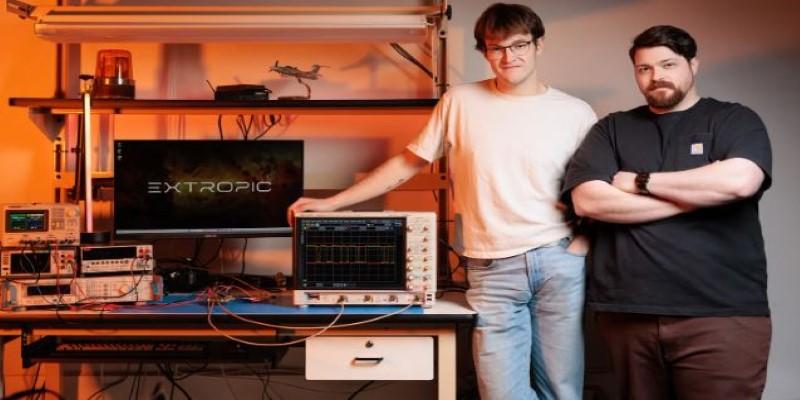
But variability is a problem. Physical systems are noisy. Unlike digital bits that cleanly snap between 0 and 1, thermodynamic states are analog, often sensitive to environmental factors. That makes reproducibility a concern. Calibration and error correction need to be handled differently, often by embedding redundancy or real-time sensing into the chip.
Scalability is another constraint. Most working thermodynamic chips are small, often solving toy-sized problems. Connecting them into larger, controllable systems introduces interference and feedback effects that need to be managed. Power efficiency is promising—the chips use orders of magnitude less energy per operation—but that comes with limits on speed and I/O bandwidth. Embedding them into conventional computing systems requires new interface protocols.
Potential Impact on AI and Beyond
If thermodynamic computing matures, its most immediate impact won’t be general-purpose computing. It will be in accelerating specific bottlenecks. AI workloads are an obvious fit. Training large models today involves enormous energy use, particularly during optimization phases. Even inference tasks, when personalized or multi-modal, can benefit from faster convergence on complex inputs. Thermodynamic systems might act as accelerators for these parts—like a GPU but tailored for energy-based reasoning.
Their behavior also opens up new modeling strategies. In probabilistic programming, for instance, systems often need to sample from complex, high-dimensional distributions. Thermodynamic chips could support native sampling, where the final system state directly corresponds to a valid sample from a Boltzmann-like distribution. That’s something digital methods still struggle with under time or power constraints.
There’s also interest in how these chips could contribute to decentralized AI systems—models deployed across sensors or edge devices. Because thermodynamic systems are inherently low-power and self-stabilizing, they could be embedded into materials or mechanical systems. Think of soft robots that adapt their control logic based on environmental changes, or embedded controllers in bioelectronic devices. In those contexts, computing becomes part of the physical response, not just a layer on top.
The tradeoffs are real. Programming these systems is difficult. You don’t write code in the conventional sense. You configure boundary conditions and system parameters. Testing and debugging are closer to experimental physics than software engineering. But for use cases where the problem structure is known and static—like logistics planning or signal decoding—the setup cost can be amortized over massive speed and efficiency gains.
Conclusion
Thermodynamic computing is still early-stage, but its momentum is building. The shift from symbolic to physical computation marks more than a technical change. It reimagines how problems are expressed, solved, and embedded into machines. These chips won’t replace CPUs or GPUs. They’ll augment them in areas where those tools falter. As AI workloads grow in complexity and energy cost, the need for new forms of optimization becomes urgent. Thermodynamic processors bring a different physics to the table—one that might fit naturally with the probabilistic, energy-based nature of real-world computation. If the current experiments scale, they could become a quiet but significant force in computing’s evolution.